
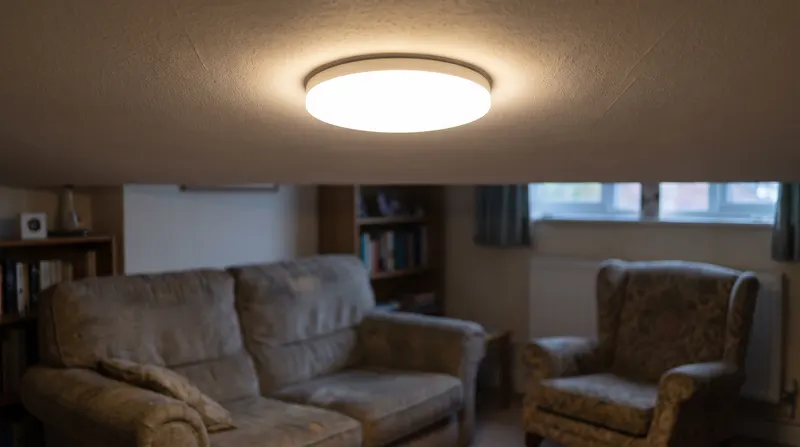
LED ceiling lights cover a wide range of fittings — flush discs that sit tight against the ceiling, semi-flush fittings with a short drop, and recessed downlights set into the ceiling itself. Which one suits a room has more to do with ceiling height and the look you're after than with the electrics, but the electrics decide what you can actually fit without extra work.
Integrated LED or a bulb you can replace
A lot of flush LED fittings now have the LEDs built in rather than taking a separate bulb, which gives a slimmer design but means the whole fitting gets replaced, not just a bulb, once the LEDs eventually dim with age. Fittings that take a separate lamp — a GU10 downlight is the common example — cost a little more to run over the fitting's life but let you change colour temperature or brightness later just by swapping the lamp.
What the ceiling rose is actually wired for
Most British ceiling lights are wired on what's called the loop-in method: the ceiling rose or junction box is where the lighting circuit's live, neutral and switched live all meet, and the light fitting connects into that same point. A straightforward flush or pendant fitting generally drops onto this without trouble. Recessed downlights are a different job — several fittings sharing a run of cable through the ceiling void, usually wired back to a junction box rather than a single rose — which is why swapping one pendant for a bank of downlights is a rewiring job, not a fitting swap.
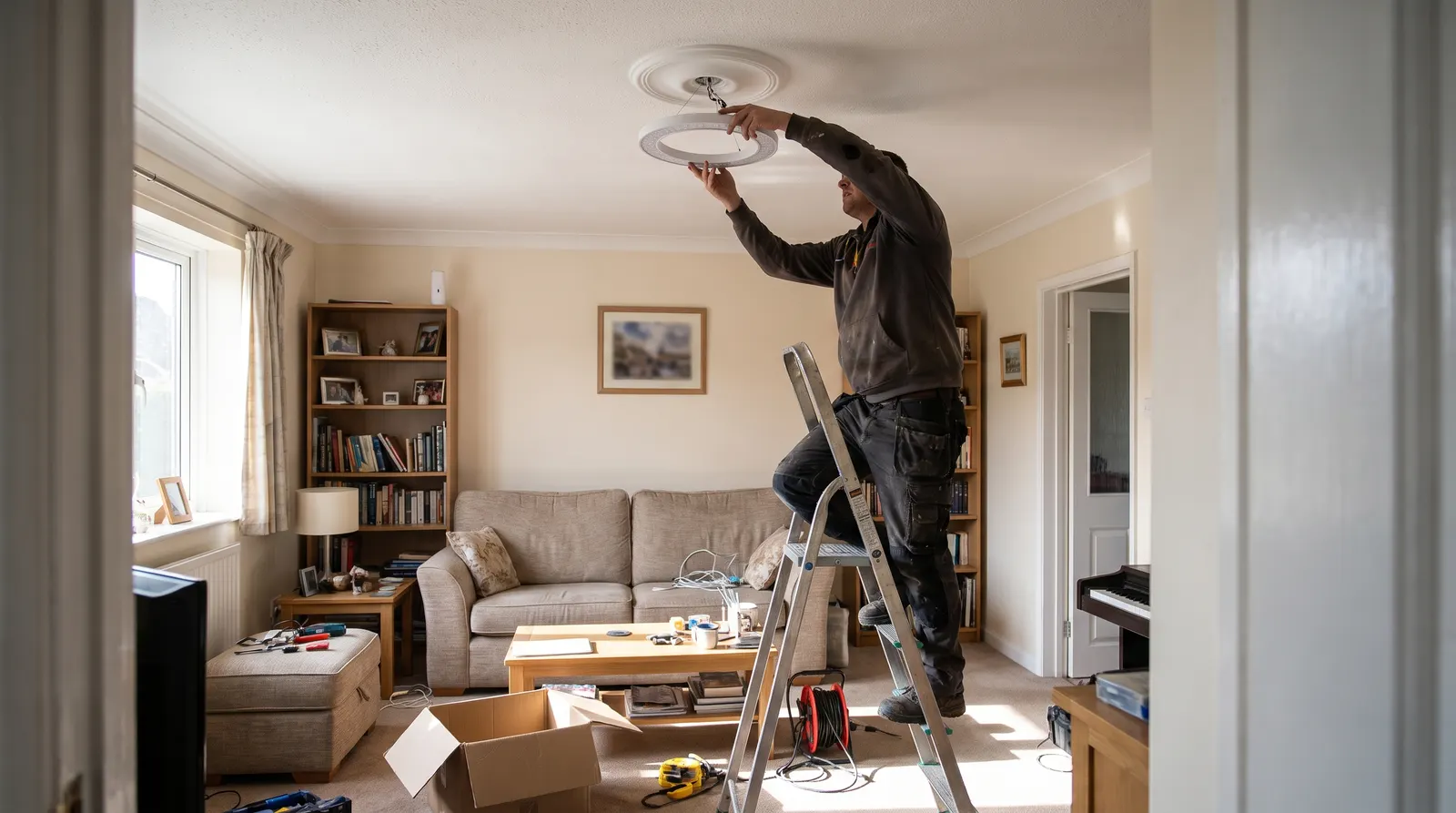
Weight, and why a heavy fitting needs more than the rose
- A standard ceiling rose is only rated for a light fitting, not a load-bearing hook — a heavy pendant or a fitting with a shade needs a proper ceiling hook or a batten fixing taking the weight, not the terminals inside the rose.
- Isolate the lighting circuit at the consumer unit before any fitting comes down, and test it is dead rather than trusting the light switch.
- Match live, neutral, earth and switched live to the new fitting's terminals by their markings, not by which wire happened to be in which hole on the old one.
- Where several lights share one switch, check the new fitting draws a similar or lower wattage than what it replaces, so the switch and cable are not asked to carry more than they were sized for.
Colour temperature and dimming
LED ceiling lights are sold by colour temperature as much as by brightness — a warm white around 2700-3000K suits a living room or bedroom, while a cooler 4000K or above reads as a more clinical light, better suited to a kitchen or utility room than somewhere you relax. If the fitting is going on a dimmer, check the lamp or fitting is actually marked dimmable before you buy it — a non-dimmable LED on any dimmer can flicker or refuse to dim smoothly, which is a mismatch we've covered in more depth separately.
We fit and rewire ceiling lighting as part of general sockets and lighting work across London, Essex and north Kent, including the junction box work a bank of downlights actually needs behind the scenes.
If you are unsure, it is always cheaper to ask than to guess. Give us a call and we will tell you straight.