
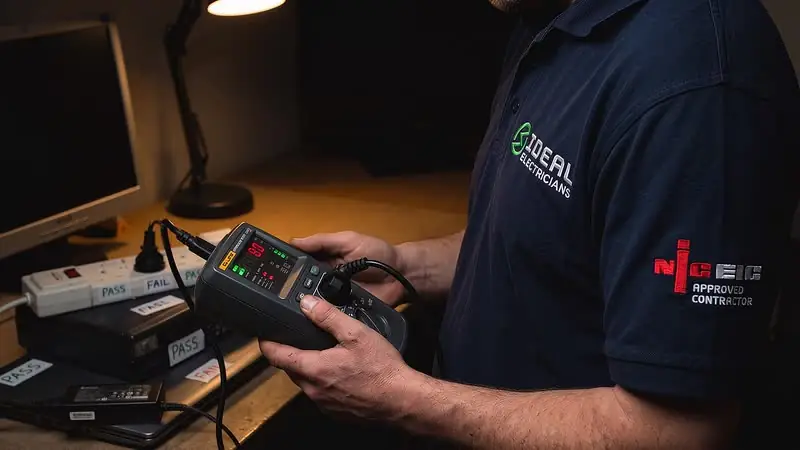
Portable appliance testing
- Rate
- Around 10 items an hour, certificate included
- Output
- Every item labelled, full register issued
- Interval
- Risk-based — there is no legal figure
No law is actually called "PAT testing". The duty comes from the Electricity at Work Regulations 1989, which require electrical equipment to be maintained in a safe condition — testing is simply how that is evidenced.
How often, really
There is no legally fixed interval, so anyone quoting you one is quoting guidance. These are the ranges that guidance commonly uses — a starting point, not a rule.
| Equipment | Typical interval | Why |
|---|---|---|
| Construction site tools | 3 months | Hard use, wet, dragged across sites. |
| Industrial and workshop equipment | 6–12 months | Heavy duty, moved often, exposed to damage. |
| Commercial kitchen equipment | 12 months | Heat, water and constant handling. |
| Handheld office equipment | 12–24 months | Kettles, heaters, vacuums, anything with a flex that gets pulled. |
| Stationary office IT | 2–4 years | Sits on a desk and never moves. Lower risk, longer interval. |
Tell us what you have got and roughly how many, and we will tell you what it takes.
Talk it through07502 396654What you are left with
Every item labelled, and a register recording what was tested and when. That register is the thing an insurer or an enforcing officer actually asks to see.
A large share of the faults found are visible ones — a damaged flex, a badly wired plug, a cracked casing — which is why the inspection half is not a formality.

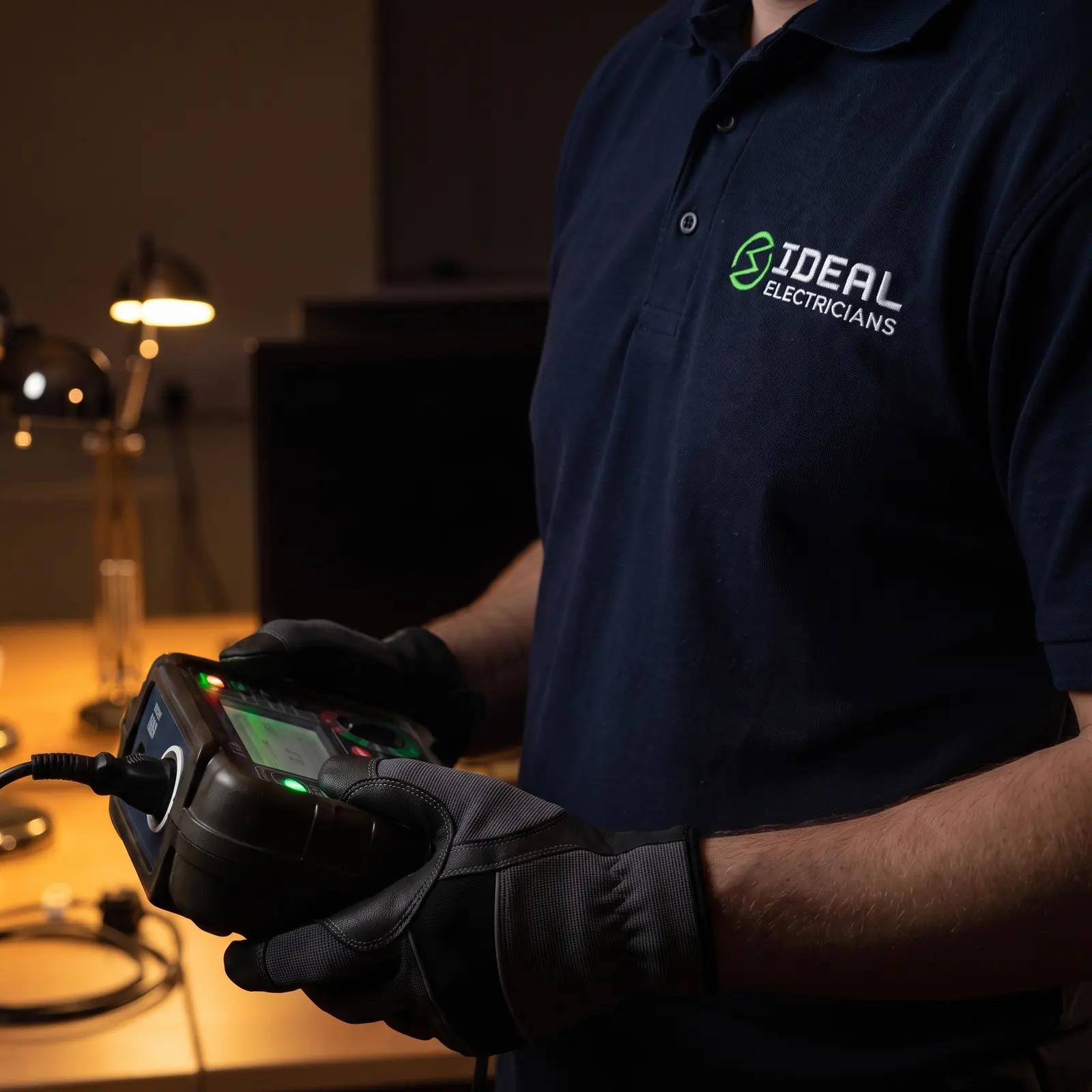
Where the duty comes from
Because the duty is about maintaining safety rather than performing a specific test, there is no legally fixed interval. Frequency is risk-based: a power tool on a building site needs checking far more often than a desktop computer that never moves.
The work is a combined inspection and test. A large share of faults found are visible ones — damaged flex, a badly wired plug, a cracked casing — which is why the visual inspection is not a formality.
What you are left with is a labelled item and a register recording what was tested and when. That register is the thing an insurer or an enforcing officer actually asks to see.
Office, shop, site or rental?
Tell us roughly how many items and where they are. No call-out fee, and charged by the hour.
What people say
Corgi Homeplan, with whom I have a central heating maintenance contract, had recommended Mizan to effect some electrical repair which my contract did not cover. … Competence 10, punctuality 10, demeanour/courtesy 10.
Ahmad K. — Referred by CORGI Homeplan This is the third time I’ve used this gentleman. I would highly recommend him — each time he was here within the hour.
Charles T. — Repeat customer
5 from 188 reviews on Google.
See everything we doBook PAT testing.
NICEIC approved, fully insured, and every item labelled with a register you can hand to an inspector.
PAT testing: common questions
The things people ask us on the phone about this one.
Not covered here? Ring 07502 396654 and ask.
Is PAT testing a legal requirement?
The law requires electrical equipment to be maintained in a safe condition; it does not name a test or an interval. Inspection and testing of portable appliances is the accepted way of demonstrating you have done it.
How often should appliances be tested?
It depends on the equipment and the environment rather than the calendar. A drill on a building site and a desk lamp in an office do not need the same interval, and the risk assessment sets it.
What gets tested?
Anything with a plug that connects to the fixed installation. Each item is inspected as well as tested, because a fair number of faults are found by looking rather than by the tester.
What happens if something fails?
It is labelled as failed and taken out of use, so nobody plugs it back in by accident. Whether a simple fault like a damaged plug or flex gets put right there and then depends on the item and on what else is booked in that day. Anything internal is a repair or replacement decision for you.