
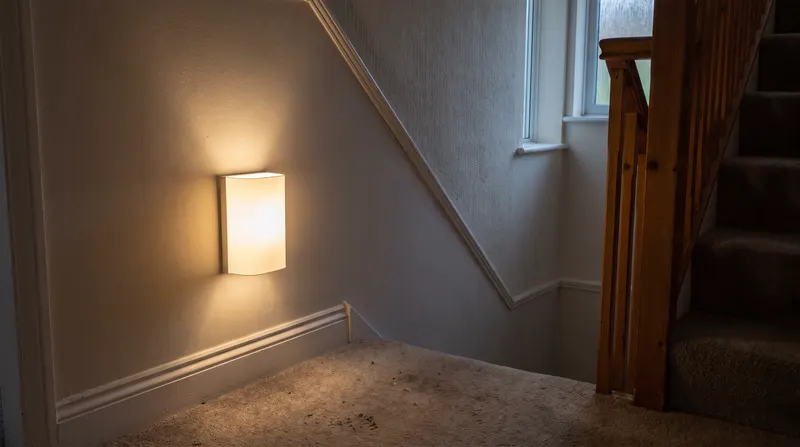
A wall light does a different job to anything on the ceiling. Fitted at around head height rather than overhead, it lights a wall, a stretch of landing, or a small area beside something — a bed, a mirror, a front door — rather than the whole room. That makes it worth choosing for what it is actually meant to light, not as a cheaper stand-in for a ceiling fitting.
Where a wall light actually earns its place
Hallways and staircases are the classic spot — a run of wall lights spaced along a landing or up a stairwell gives even light along a route without a line of pendants overhead, and on a staircase it can mark the treads better than a single light at the top ever does. Either side of a bed is the other obvious one: a wall-mounted reading light frees up the bedside table and removes a trailing lamp flex, which matters more than it sounds like until you've lived with one. In a living room, a wall light is usually there for atmosphere alongside the main light rather than instead of it.
Uplighter, downlighter, or both
Which way the fitting throws its light decides what it is actually for. An uplighter washes light up the wall and across the ceiling, which reads as ambient and flattering rather than functional — good for atmosphere, no good as a reading light. A downlighter does the opposite, casting a defined pool of light downward, which is what you want beside a bed or over a step. Some fittings do both from the same body, which suits a hallway better than either one on its own, spreading light up and down the wall rather than leaving a band in the middle unlit.

Behind the fitting, it isn't always the same job as a ceiling light
A ceiling light usually drops onto an existing point — the rose or the wiring behind it is already there, looped into the circuit, and the fitting just has to match the terminals. A wall light is far more often going in somewhere nothing has ever been wired before, which means a new cable run chased into the wall or taken along it back to the lighting circuit, not just a fitting swap. Where that's the case, it's worth having an electrician look at the route before anything goes on the wall, rather than after a chase has already been cut.
Dimmers behave the same way they do on any other LED fitting
If a wall light is going on a dimmer, the same mismatch applies as with any other LED fitting — a dimmer built for an old incandescent load doesn't always read an LED driver cleanly, and the result is flicker or a dim that won't go all the way down, which we've covered in more depth separately. Check the fitting and the dimmer are both actually rated for the load before assuming one of them is faulty.
We fit and wire wall lights as part of general sockets and lighting work across London, Essex and north Kent, including the cable work a new position usually needs behind the wall.
If you are unsure, it is always cheaper to ask than to guess. Give us a call and we will tell you straight.