
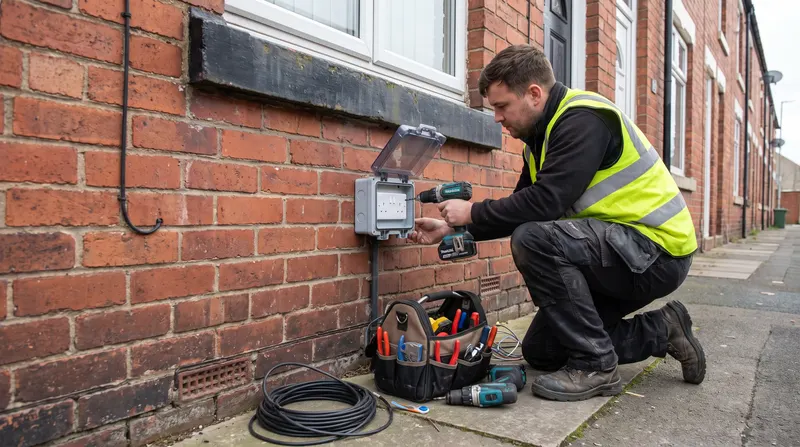
An outdoor socket has to cope with rain, condensation and being left plugged into something for months at a time, none of which an indoor socket is built for. Done properly it is a straightforward, genuinely useful addition — power for a mower, a pressure washer or outdoor lighting without a cable trailing out of a window. Done badly, it is one of the more common reasons an RCD trips after wet weather.
RCD protection is not optional here
Any socket you might reasonably use outdoors needs to be on a circuit protected by a 30mA RCD — this has been standard practice for years precisely because sockets are where most shock risk and water ingress show up. If you're adding an outdoor socket to an older installation, that is the point to check: a consumer unit without RCD protection on its sockets needs that sorting before the new socket is worth fitting at all.
The enclosure is doing the actual work
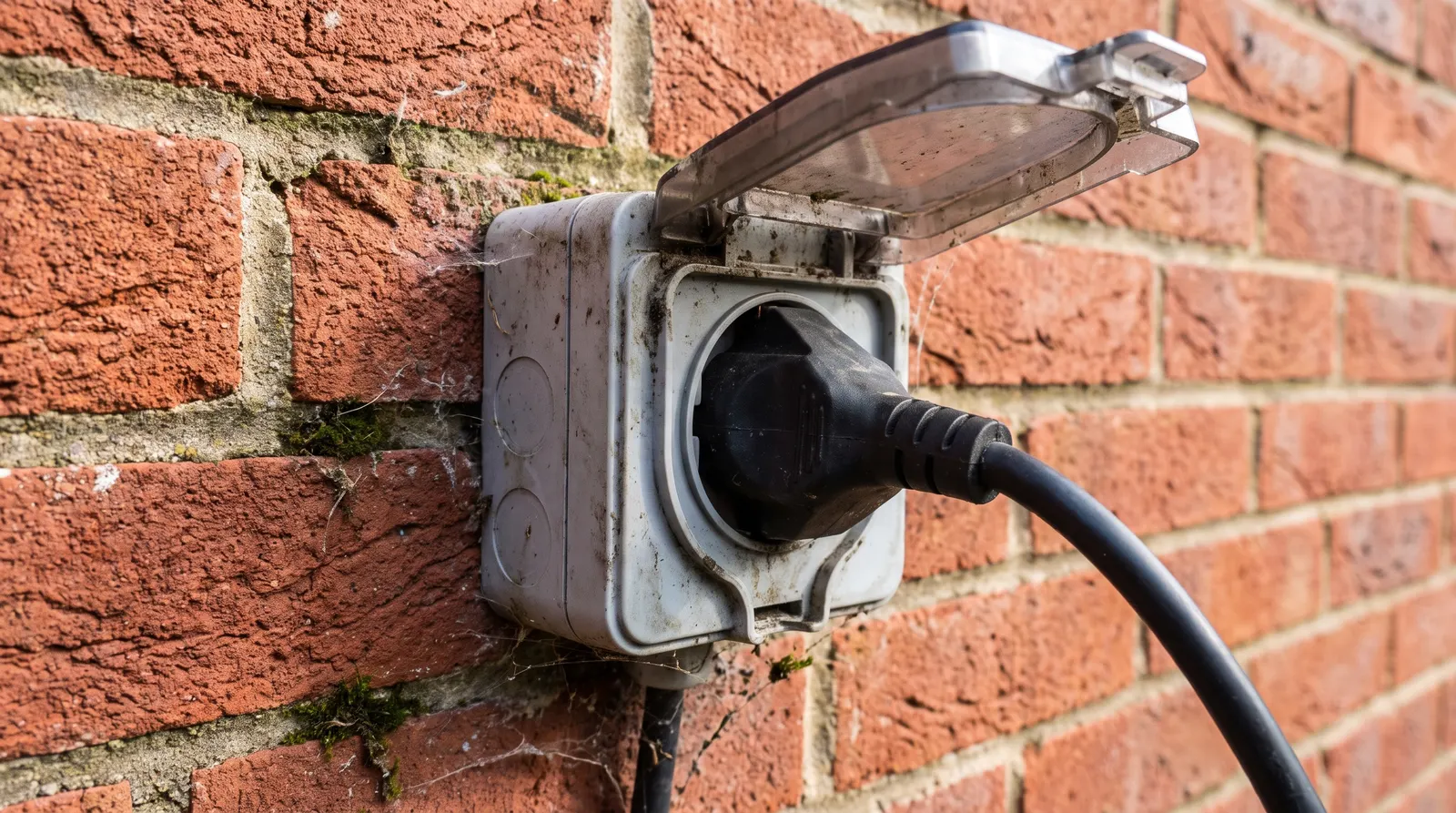
A socket sold as 'outdoor' is really a socket in a weatherproof enclosure — a hinged, spring-loaded cover that drops shut over the faceplate when nothing is plugged in, and still closes down far enough around a plug and cable to keep most of the weather out while something is connected. The usual expectation is that the socket keeps a reasonable degree of splash protection even with a plug in and the lid held open by the cable, which is the point a cheap, loose-fitting cover tends to fail at. For anywhere properly exposed — a gate pillar, an open patio, anywhere that gets driving rain — a better-sealed, more heavily built enclosure earns its keep.
How it should be supplied
An outdoor socket wants its own run back to the consumer unit, or a properly sized spur off an existing circuit — not a plug-in adaptor and definitely not an extension lead run out through a window and left there. We've covered what a fused spur actually is and when one is the right call separately; the short version outdoors is the same as anywhere else, just with weatherproof accessories throughout and a cable route that is protected the whole way, not just at the ends.
Siting it sensibly
- Mount it well clear of ground level, away from anywhere water can pool or snow can bank up against it.
- Keep it out of the direct line of a hosepipe, sprinkler or a gutter downpipe that overflows in heavy rain.
- Route the cable so any water on it runs away from the socket rather than down into it.
- Position it where the cover can swing fully open — a socket squeezed behind a drainpipe or under low decking never gets used properly, and that is when people start propping the lid open with something.
We fit outdoor sockets as part of our general sockets and lighting work across London, Essex and north Kent, sited and supplied properly rather than retrofitted onto whatever circuit happens to be nearest.
If you are unsure, it is always cheaper to ask than to guess. Give us a call and we will tell you straight.