
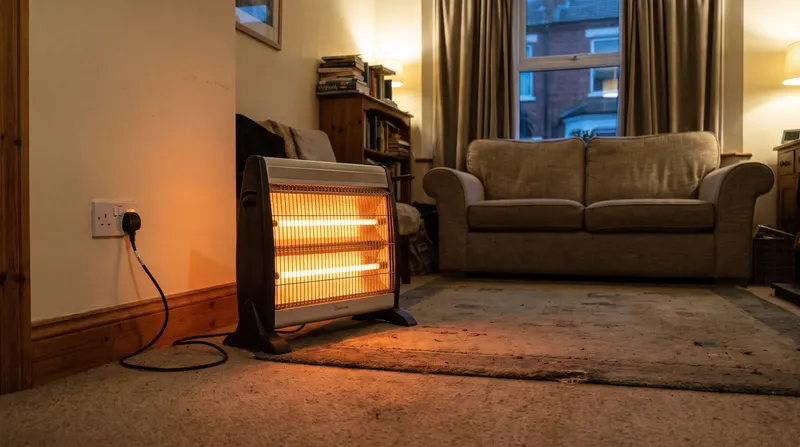
A halogen heater is the cheap freestanding heater with the glowing orange bars behind a wire guard, usually on a tilting stand. Inside each bar is a halogen gas-filled tube that heats almost instantly and throws heat out as radiant energy rather than warming the air first, which is why it feels hot the moment you switch it on and why people reach for one as a quick fix for a cold room.
Radiant heat behaves differently to a fan heater
A fan heater warms the air around it and spreads that warmth as it circulates. A halogen heater does something more direct: the glowing element radiates heat in a fairly narrow beam, like a small version of standing in front of a fire. Anything sitting in that beam gets far hotter, far faster, than the room temperature around it would suggest — which is the part people underestimate.
Why it catches things alight
Because the heat is directional rather than general, a halogen heater can scorch or ignite something close to it well before the room itself feels warm. A curtain that drifts into the beam, a clothes airer left to dry nearby, bedding, or a dressing gown draped over a chair back are the kind of ordinary, everyday things that sit near a cheap heater without anyone giving it a second thought — and they're exactly what fire services keep seeing involved when a halogen heater causes a fire.
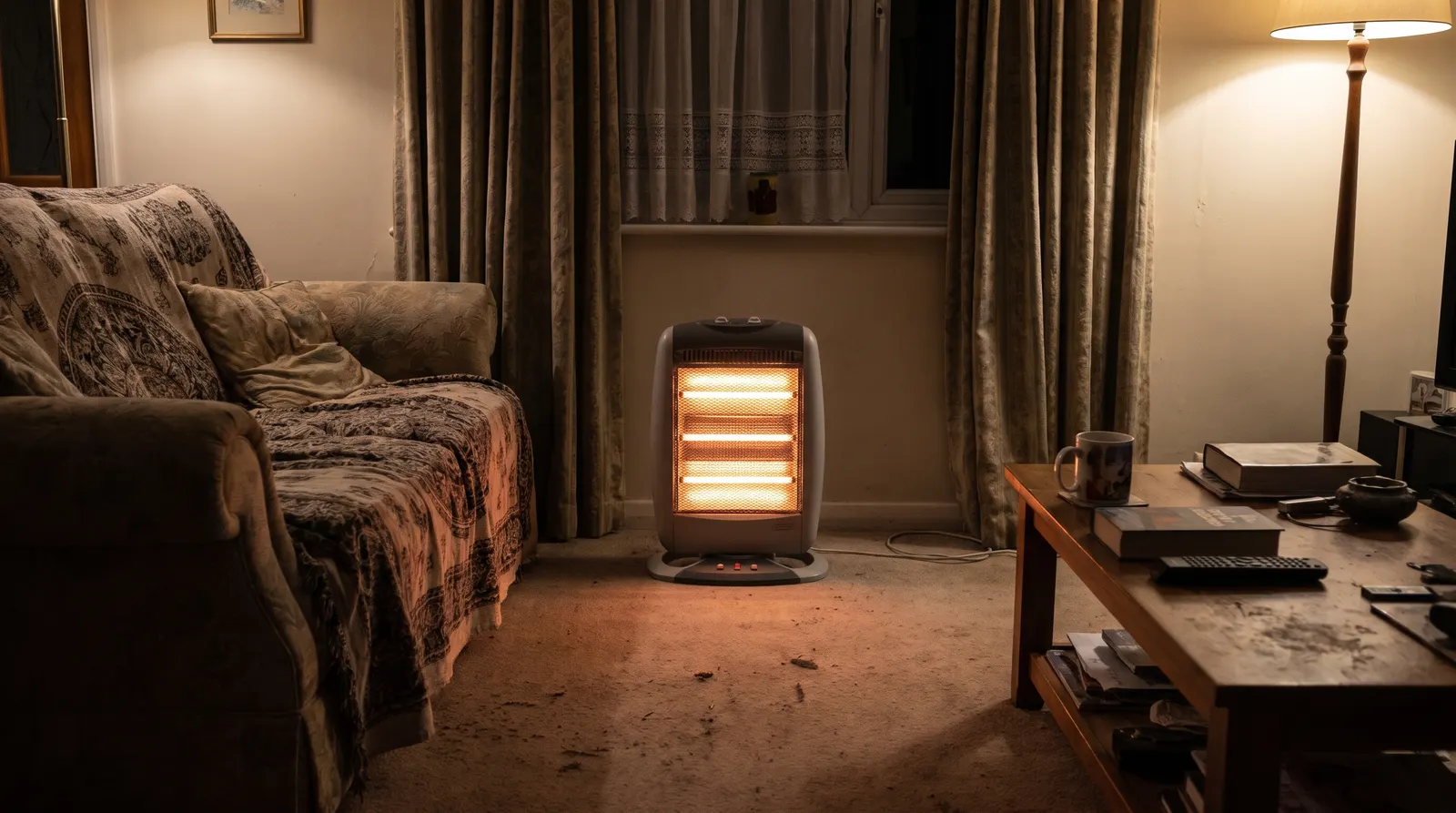
The wire guard on the front stops you touching the element directly, but it does very little to stop radiant heat reaching whatever is placed close to it. Treat the guard as protection against contact, not as proof the heater is safe to stand near soft furnishings.
The same socket rules as any other portable heater
Electrically, a halogen heater draws a similar current to a fan heater or an oil-filled radiator, so the same loading rules apply: plug it straight into a wall socket on its own rather than through an extension lead or a multi-way adaptor already carrying something else. We've covered that overload risk in more detail for fan heaters, and it applies here just as much.
- Keep it clear of curtains, furniture, bedding and anything hung to dry, on every side — not just in front of the bars.
- Never use it to dry clothes or towels, and never drape anything over it, even for a moment.
- Stand it on a flat, hard, level floor, never on a rug or carpet where it can be nudged or where it could tip.
- Check whether yours has a tilt switch that cuts the power if it's knocked over — many newer models do, but don't assume an older one does without checking.
- Never leave it running unattended, and never overnight, especially in a bedroom.
A halogen heater has its place as a short-term, occasionally-used heater, used properly and watched while it's on. If a room needs heating often enough that one is running for hours at a time, that's a sign the room would be better served by something fixed and thermostatically controlled. We fit fixed heating and the sockets that supply it as part of general electrical work across London, Essex and north Kent, and we've written separately about where a fan heater earns the same caution.
If you are unsure, it is always cheaper to ask than to guess. Give us a call and we will tell you straight.