Ideal Electricians

Post Image
02 Sep, 2026
Posted by admin
0 comment

E-Bikes, E-Scooters and the Charger by Your Front Door: A Home Safety Check

Walk down pretty much any street in East London these days and you’ll spot it: a delivery rider’s e-bike parked in the hallway, a fold-up e-scooter propped against the radiator, a charging cable trailing from the kitchen socket to somewhere near the front door. Two wheels and a battery have quietly become as normal as a bike shed used to be.

We’re not here to tell you to give it up — e-bikes and e-scooters are brilliant, and half of Dagenham seems to be commuting on one. But the battery that gets you to work is also the thing our colleagues in the fire service worry about most right now, and it’s worth five minutes of your evening to make sure yours is charging the right way.

Why this particular battery gets special attention

Lithium-ion batteries are generally very safe. The trouble starts when one is damaged, counterfeit, charged with the wrong charger, or simply left to its own devices for hours on end. When one does fail, it doesn’t smoulder politely — it can ignite in seconds and burn with a ferocity that catches people out, producing thick, toxic smoke well before anyone notices a problem.

London Fire Brigade now attends a fire involving an e-bike or e-scooter lithium-ion battery on average every two days in the capital, and their figures show most of those fires start while the battery is charging. That’s not a reason to panic. It’s a reason to treat the charging point the same way you’d treat any other serious electrical load in your home.

The five-minute charging check

Use the charger that came in the box

Only ever use the manufacturer’s charger, or a genuine replacement bought from the manufacturer or a retailer you trust. A cheap generic charger picked up online to replace a lost one is one of the most common causes of battery fires — the small saving is not worth it.

Give it a proper socket, not a chain of leads

Plug the charger directly into a wall socket. Don’t run it through a string of extension leads or a coiled cable reel, and don’t share that socket with three other things. If your hallway or garage doesn’t have a socket near where you actually want to charge, that’s a job for us, not a longer extension lead.

Charge somewhere you’d notice a problem

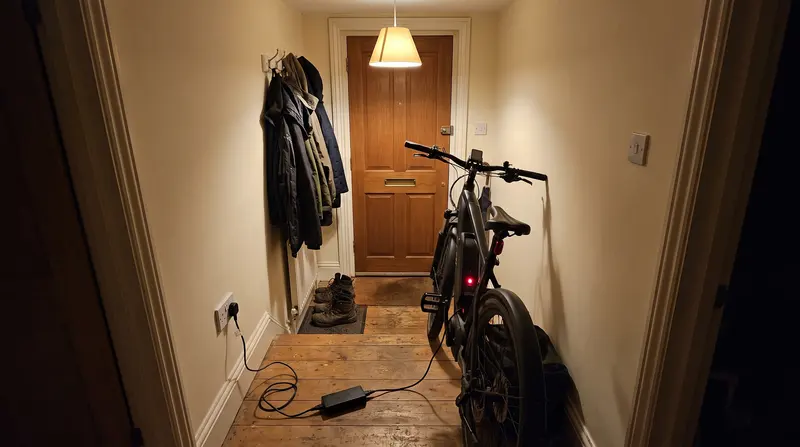
Never charge in a hallway, stairwell or anywhere near your only way out — if something does go wrong, that’s exactly the route you’ll need. And never leave a battery charging overnight or unattended while you’re out. Once it’s done, unplug it; there’s no need to leave it topped up on trickle charge for hours after it’s finished.

Check the battery itself

Look it over before you charge: no cracks, no dents, no swelling, nothing that’s been dropped or soaked. A battery that’s puffed up or misshapen has already failed — stop using it, don’t charge it again, and contact the manufacturer about safe disposal.

Ceiling-mounted smoke alarm, essential in any room where batteries are charged overnight
A working smoke alarm near your charging point is the cheapest insurance you’ll ever buy. Photo by Caleb Oquendo on Pexels.

Where we come in

Most of what makes battery charging safer isn’t about the bike at all — it’s about the electrics behind the socket. A few things we’re regularly asked to sort out for e-bike and e-scooter owners across East London and Dagenham:

A dedicated socket where you actually need one

If you’re charging in a garage, porch or hallway that currently has no socket nearby, we can fit one properly — on its own circuit if the load calls for it — so you’re not relying on a lead stretched across a floor people walk through.

RCD protection

Every socket circuit should be protected by an RCD (residual current device), which cuts the power in a fraction of a second if something develops a fault. Older consumer units sometimes don’t have full RCD coverage — worth checking, especially if you’re charging something daily.

Smoke alarms where they’ll actually help

A working smoke alarm near your charging area buys you the early warning that makes the difference. We can fit interlinked alarms so if one goes off, they all do, wherever you are in the house.

An EICR if it’s been a while

If nobody’s inspected your wiring in the last decade, an Electrical Installation Condition Report checks your circuits, earthing and consumer unit are up to the job of the modern home you’re actually living in — chargers, e-bikes and all.

Give us a shout

NICEIC Approved, City & Guilds qualified, covering East London, Dagenham and the surrounding areas. No call-out fees, and 24/7 for anything that genuinely can’t wait.

Extra sockets, RCD upgrades, smoke alarms or a full EICR — whatever gets your charging point off the extension lead and onto something safer, we’re happy to help.

Give us a call on 07502 396654.

Ride safe. Charge safer.

Leave a Comment

Your email address will not be published.*

Recent Comments

No comments to show.

Archive

September 2026
M T W T F S S
 123456
78910111213
14151617181920
21222324252627
282930  

Tags

Recent Posts

Close-up of an e-bike battery mounted on a rear rack, the kind that needs safe charging at home
02 Sep, 2026

E-Bikes, E-Scooters and the Charger by Your Front Door: A Home Safety Check

Half of East London seems to commute on two wheels now, and every one

18 Dec, 2023

Why Regular PAT Testing Matters for London Landlords

For businesses and landlords in London, maintaining a safe environment