
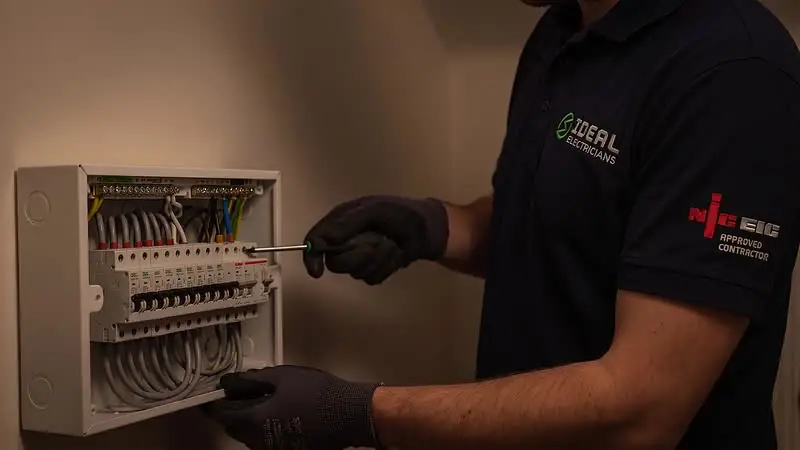
Fuse board & consumer unit upgrades
Replace an old rewireable or plastic board with a modern RCBO unit that cuts the power the instant something goes wrong.
- Full RCD and RCBO protection
- Metal-clad to current regulations
- Certificate issued and notified
No call-out fee. Charged by the hour, with a rough estimate before we start.
A consumer unit is the protective heart of the installation. If yours still has rewireable fuses or plastic casing, it is working to standards that have since been superseded.
What a board change involves
The board is swapped, every circuit is tested against it, and the installation is certified and notified under Part P by us.
- One day
- A standard board change, with your power back on the same day
- SPD
- Surge protection fitted as standard on a new installation
- Part P
- Notified to building control by us, so you never deal with them
Tell us what you are after and we will tell you what it involves.
Speak to an electrician07502 396654
The detail
Rewireable fuses protect cable from overload, but they do not protect people from electric shock, and they cannot detect an earth fault. RCD protection does, by comparing the current flowing out with the current returning and cutting the supply when the two do not match.
Since 2016 consumer units in domestic premises have been required to have a non-combustible enclosure, which in practice means steel rather than plastic. That change followed a run of fires starting at loose terminals inside plastic boards.
A modern board is usually specified with RCBOs — one device per circuit, combining overload and earth-fault protection. The practical benefit is that a fault on one circuit no longer takes out half the house, which matters most for freezers, alarms and anything else you would rather not find switched off.
Signs your board is due
- Rewireable fuses, or fuse carriers you pull out
- A plastic or wooden enclosure
- No RCD protection at all
- A board that trips whenever it rains
- No spare ways left for new circuits
Want fuse board & consumer unit upgrades doing?
Tell us what you are after and we will tell you what it involves. No call-out fee, and the line is answered whatever the hour.
What people say
Mizan is very professional. He arrived at the time he said and called me 30 minutes before arrival. He done the works very well and cleaned up after himself. Very satisfied and I will use him again.
Nasrin B. — Scheduled work This is the third time I’ve used this gentleman. I would highly recommend him — each time he was here within the hour.
Charles T. — Repeat customer
4.9 from 181 reviews on Google.
One number, answered around the clock.
NICEIC approved, fully insured, and every job tested and certified.
Fuse board & consumer unit upgrades: common questions
The things people ask us on the phone about this one.
Not covered here? Ring 07502 396654 and ask.
Do I need a new consumer unit?
If yours still has rewireable fuses, no RCD protection, or a plastic enclosure, it is behind current standards. An EICR will tell you whether it is a recommendation or an actual danger, and the report codes say which.
How long does a consumer unit change take?
A straightforward change is usually a day, and the power is off for a good part of it. What extends it is what testing finds once the board is off, which is why we test before we commit to a plan rather than after.
Will a new board fix my tripping?
Not on its own. A modern board with RCBOs isolates a fault to one circuit instead of taking out half the house, but the underlying fault still needs finding and fixing.
Do I get a certificate?
Yes. A consumer unit change is notifiable work and is certified and notified under Part P. The paperwork follows the job rather than arriving on the day, and it can take a few days to come through.
Will I get surge protection?
A new installation will include SPD. On a board change it depends on the board and the installation, so it is something to look at on the day rather than promise in advance.