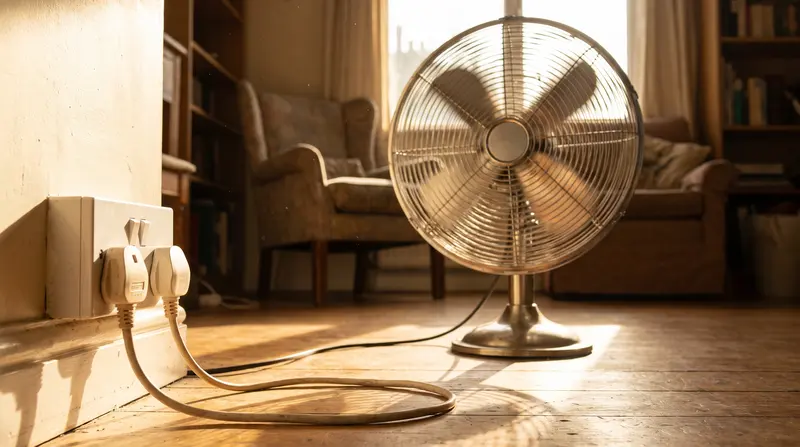
Every British summer follows the same script. Three days of genuine heat, the nation collectively loses its mind, and somewhere in every home there’s a socket behind the sofa with an extension lead plugged into another extension lead — running a fan, a phone charger, a laptop and, for reasons nobody can quite explain, a slow cooker.
We’re electricians, so we notice these things. We also get the call-outs afterwards, which is the part we’d much rather help you avoid.
Electricity makes heat. That’s not a fault, it’s just physics — every cable, plug and connection warms up a little when current flows through it. In February that warmth vanishes into a cool room and nobody notices. In August, in a loft, behind a sofa, with a fan running twelve hours a day, it has nowhere to go.
So a connection that was slightly loose all winter — quietly, harmlessly loose — starts to get hot. Then hotter. And a loose connection that gets hot enough is how a fire starts.
London Fire Brigade has attended more than 26,000 electrical fires in the capital since 2017, and averages around 24 a week caused by chargers, batteries and cables alone. This July they issued a specific warning about cheap fans after a run of incidents: a battery that exploded while charging and lodged its own casing in a ceiling, a flat fire in Southwark from a fan left running for several days, a bed fire in Plumstead. One owner was burned the very first time they switched a fan on.
We’re not telling you that to ruin your summer. We’re telling you because nearly every one of those started with something that could have been spotted.

Warm is fine. Hot is not. And if the faceplate has gone brown, or there are scorch marks around the pins, stop using that socket today — not at the weekend, today.
Buzzing from a switch, a whiff of something fishy or burning near a socket, lights that flicker or dim for no reason. Your installation isn’t being dramatic. It’s telling you something is wrong.
Portable air-con units, tumble dryers, washing machines and heaters pull serious current. One plug, one socket — no block adaptors, and no daisy-chaining leads together. This is the single most common thing we find.
All of it, every time. A coiled cable drum can’t shed its heat and will overheat well below the load it’s rated for. It’s the least intuitive rule in this whole article and one of the most important.
A UK 3-pin plug and a British or European safety mark, from a seller you’ve actually heard of, beats a bargain off a social-media ad or a market stall every single time. Don’t run one overnight, don’t leave one going for days while you’re out, and don’t stand it where it can topple onto a duvet or a curtain.
And while you’re up: test your smoke alarms. Ten seconds. It is, by a distance, the thing most likely to make the difference if something ever does go wrong.
If you’ve found scorch marks, a hot socket, a burning smell, or a breaker that keeps tripping and you keep resetting it — that’s a job for us, not a weekend DIY. Resetting a breaker that’s trying to warn you is the electrical equivalent of putting tape over the warning light on your dashboard.
The same goes if nobody has properly inspected the place in a decade. An Electrical Installation Condition Report (EICR) checks your wiring, earthing, bonding and consumer unit, finds the overloaded circuits, and hands you a plain-English list of what needs putting right. Landlords need one every five years by law. Everyone else simply benefits from knowing rather than hoping.
NICEIC Approved, City & Guilds qualified, covering East London, Dagenham and the surrounding areas. No call-out fees, and 24/7 for the things that genuinely can’t wait until morning.
EICRs, fuse box upgrades, extra sockets fitted so you can finally retire the extension-lead mountain, or an urgent look at a socket that’s getting warm — all of it, happily.
Give us a call on 07502 396654.
Enjoy the sunshine. Just not the smell of melting plastic.