
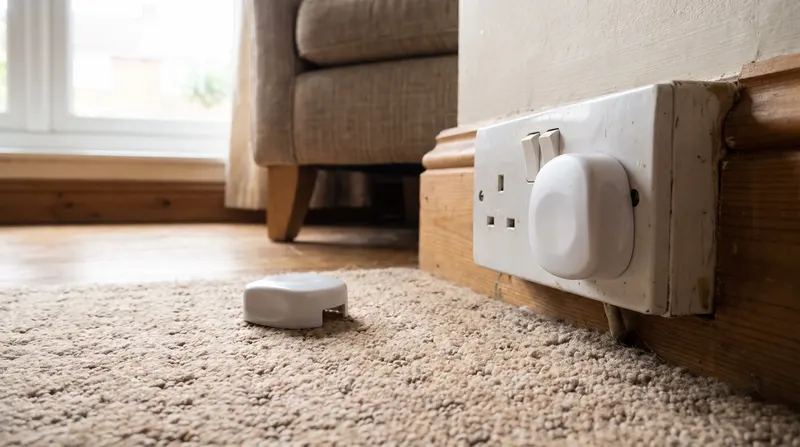
Plug socket covers — the small plastic inserts sold to push into an unused wall socket — are marketed as protection for children, but a standard UK wall socket is already built with that protection inside it. Sockets made to the British Standard that covers every socket in a UK home carry an internal shutter mechanism behind the live and neutral pin holes, which stays closed unless both pins are pushed in together at the same time, the way a real plug does it. A single object pushed into one hole on its own — a finger, a key, a hairpin — meets the shutter and goes no further.
How the shutter mechanism actually works
Look inside an empty UK socket and the two angled pin holes are not open tunnels to the contacts behind them. Each is covered by a small spring-loaded shutter that only lifts when something pushes against both the live and neutral holes at once and with roughly equal pressure — exactly what the two flat pins of a plug do, and exactly what a single object pushed into one hole cannot. This is a feature of how the socket is made, not an add-on, and it has been standard in UK socket design for decades.
Why plug-in covers caught on anyway
The habit mostly travels from abroad, or from parents who grew up around a different style of socket that genuinely was unshuttered, and the instinct to cover an electrical outlet near a crawling child is an understandable one. Covers are cheap, sold in multi-packs, and marketed with the same urgency as corner guards and cupboard locks, so they end up on the same shopping list without anyone checking whether the socket needed the extra layer in the first place.
Why safety guidance has moved away from recommending them
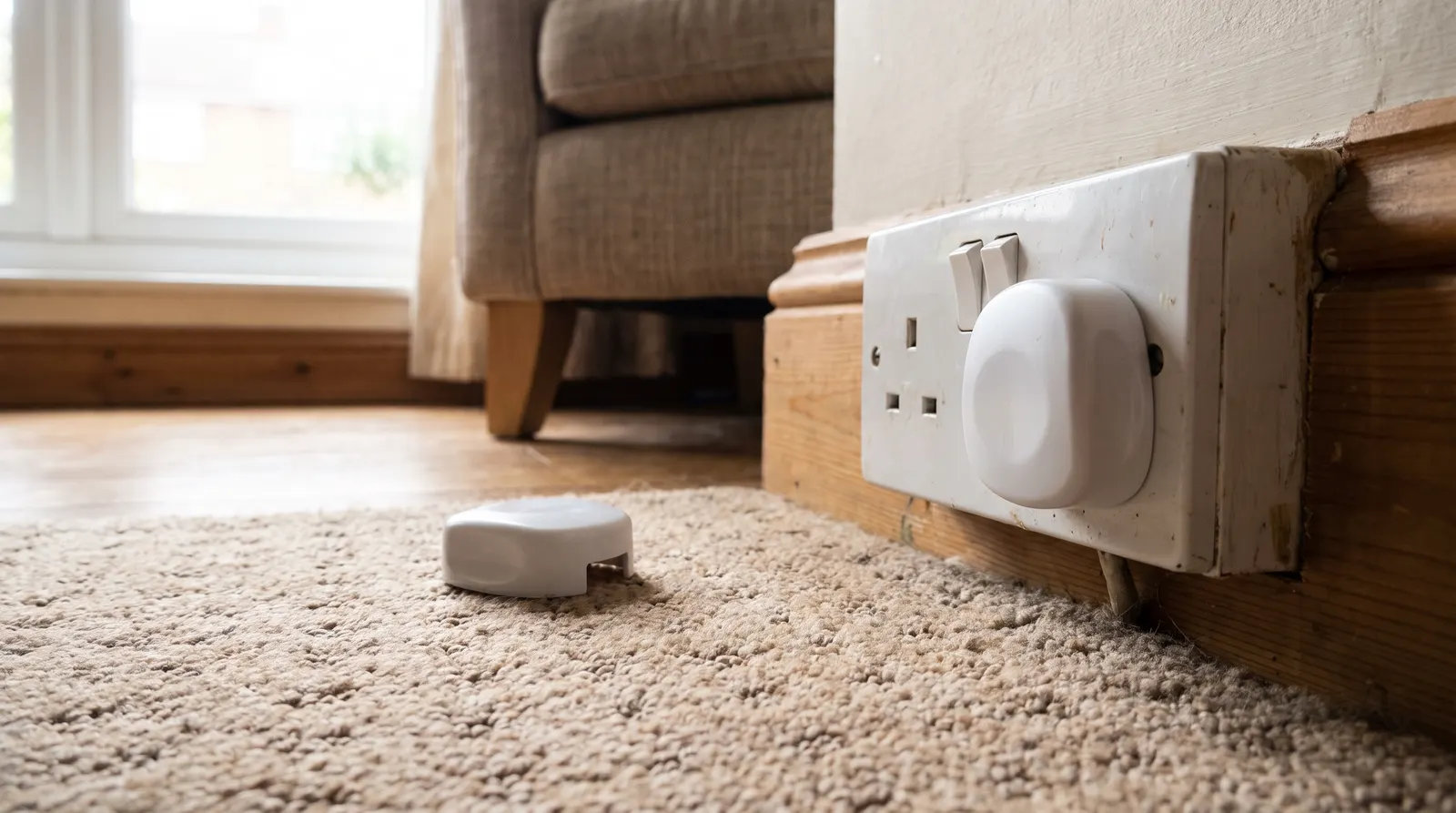
Current UK child-safety and electrical-safety guidance has shifted away from recommending separate socket covers, for reasons that have nothing to do with whether the shutter mechanism works. A cover small enough to push into a socket is also small enough to come back out and end up in a toddler's mouth, which is the choking hazard the cover itself introduces. Pulling one in and out repeatedly also teaches a young child that the socket is something to handle and investigate, which is the opposite of what the cover was bought to achieve.
The cover can damage the thing that was already protecting you
A tight-fitting plastic cover forced in and worked back out, socket after socket, puts repeated strain on the shutter mechanism behind it — a part built to respond to a plug's two pins pressed in evenly, not to a single moulded plastic lug levered about by small hands. Over time that can leave the shutter stiff, loose, or no longer closing properly, which means the socket that was doing its job unaided can end up worse off for the cover that was meant to help it.
If a socket in the house feels loose in its faceplate, has a cover that will not sit flush, or you are simply not sure whether what is fitted is doing what it should, that is worth having looked at rather than guessed at — we cover that as part of general sockets and lighting work across London, Essex and north Kent.
If you are unsure, it is always cheaper to ask than to guess. Give us a call and we will tell you straight.