
Guides
Storage heaters: what goes wrong, and what is worth repairing
By Mizan, Founder and lead engineer6 min read
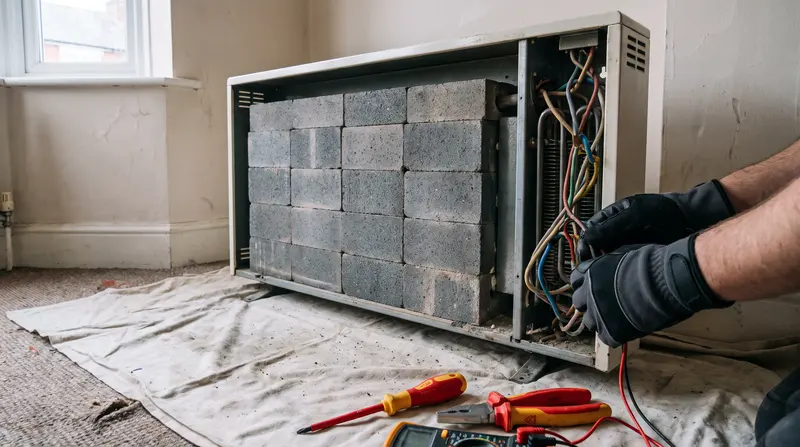
A storage heater has a job that sounds odd written down: draw cheap electricity overnight, store it as heat in dense bricks, and release it slowly through the following day. Almost everything that goes wrong is a failure of one of those three stages.
It never gets warm overnight
If the heater is cold in the morning it has not charged. The usual causes are a failed element, a failed charge controller, or — very often — nothing wrong with the heater at all, but a timing or supply problem upstream.
Check whether other off-peak appliances also failed. If the immersion did not heat either, the fault is more likely in the off-peak supply or its timing than in this one heater.
It charges but gives nothing out
A heater warm to the touch that never seems to heat the room usually has a problem on the output side: the damper controlling how much heat escapes, or the boost fan on models that have one. That is generally a straightforward repair.
It is all gone by lunchtime
Heat dumped too quickly is normally the input and output controls being wrong for the season rather than a fault. Input sets how much charge is taken overnight; output sets how quickly it comes back out. Turning output down and input up is the usual fix, and it is free.
When repair stops being sensible
Bricks and cases last a very long time; elements and controls do not. A single failed component in an otherwise sound heater is usually worth repairing. It stops being sensible when parts are no longer available for a discontinued model, when the case or insulation has broken down, or when a second and third component fail in quick succession — that is a machine telling you where it is in its life.
We work on Economy 7 and off-peak systems and repair or replace a heater you already have. We do not supply the heaters themselves.
Asbestos, on older units
Storage heaters made before the mid-1970s can contain asbestos in their insulation. If a heater is that old it is not something to open up and investigate yourself. Say so when you ring and it can be approached properly.
If you are unsure, it is always cheaper to ask than to guess. Give us a call and we will tell you straight.